
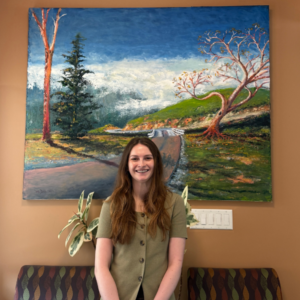
For Jennifer ” Jenny” Hatch, recovery is not just about reducing symptoms or following a treatment plan. It is about something more human: helping people feel understood, respected, and connected to a community again.
Jenny, Program Director at Bridge House, first came to Interim, Inc. nearly seven years ago after learning about the organization through a classmate at CSU Monterey Bay. At the time, she was searching for hands-on experience working with individuals living with schizophrenia, a population she felt was often misunderstood or overlooked.
“I have a deep desire to support people in feeling understood and hearing other people’s stories,” she shared. That philosophy comes to life at Bridge House. What Jenny found there challenged many of her assumptions about residential mental health care. Instead of a cold or highly clinical environment, she discovered something very different.
“It doesn’t resemble a traditional doctor-patient relationship,” Jenny said. “It’s more of a community where everyone has a voice.”
That sense of connection is central to daily life at Bridge House. Residents and staff cook together, attend outings, participate in activities, and spend time in shared spaces getting to know one another. Some of the most meaningful moments happen during everyday interactions, such as trips to appointments, conversations while preparing meals, or laughing together over a game of Uno in the common area. “A lot of the healing happens in those moments,” she said. “In community with each other.”
Bridge House operates through a psychosocial rehabilitation model, emphasizing autonomy, strengths, and recovery through meaningful connection. Rather than focusing solely on diagnosis or symptom management, the program encourages residents to rebuild confidence, rediscover personal goals, and strengthen daily living skills that support lifelong independence.
For Jenny, that approach closely aligns with her own values. “We focus on healing rather than just removing symptoms,” she explained. “We focus on people’s strengths.”
Over the years, Jenny has held multiple roles within Bridge House, beginning as a relief counselor before becoming a primary counselor and eventually stepping into leadership. She credits much of her growth not only to supporting residents, but also to what she has learned about herself along the way.
“This work challenges you to reflect a lot on yourself,” she said. “Communication skills, boundaries, time management, understanding others, all of those things grow when you’re in this environment every day.”
Residents typically stay at Bridge House for about six months, though each recovery journey looks different. Many go on to supportive housing, reconnect with family, return to school, or enter the workforce. For Jenny, one of the most rewarding parts of her role is seeing residents reconnect with their potential. “There’s so much talent among the residents we work with,” she said. “We’ve had people go on to become authors, artists, lawyers. Sometimes it’s about helping people restore belief in themselves.”
One memory, in particular, has stayed with her. Long after leaving Bridge House, a former resident told Jenny that when they looked back on their time there, they remembered it as: “a time that I felt loved.”
“That really motivates me,” Jenny shared. “Regardless of where people go afterward, for the time they were here, they had an environment where people really cared about them.” It is a perspective that has also shaped how she views mental health more broadly. “I think anybody could struggle with mental health,” she said. “We’re all temporarily able.”
For Jenny, supporting recovery means recognizing the humanity in each person and meeting them where they are, without judgment. It also means understanding that healing often begins with something simple: feeling heard, valued, and accepted.
As Monterey County continues to grow, Jenny hopes the broader community embraces that same mindset, one rooted in compassion, understanding, and connection. “We all have things we need to heal from,” she said. “If we learn to come together more, focus on our strengths, and support one another, a lot of great things can happen.”
Discover more stories and learn about our programs: Interim – News