
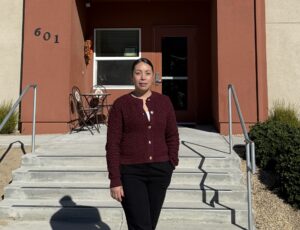
 For Miriam Gonzalez-Gomez, Interim’s Division Director of Program Services, community-based mental health care is a guiding principle shaped by lived experience and decades of leadership.
Early Life Rooted in Community
For Miriam, Interim’s Division Director of Program Services, overseeing our residential treatment programs as well as the Assertive Community Treatment (ACT) program, the concept of mental health community support began long before she ever stepped into the behavioral-health field. Born in Watsonville to a family of seasonal farm workers, she grew up between Mexico and the United States, spending her childhood moving with her parents during harvest seasons.
Her father was the “unofficial social worker” of their community. Miriam remembers riding along with him to deliver fresh fruit to older adults, checking on neighbors with disabilities, and making sure people had what they needed to live safely and with dignity. For her, this wasn’t charity. It was what community was supposed to look like — people showing up for each other, seeing each other, caring for each other.
One memory stands out: there was only one phone in the entire town. When someone received a call, a loudspeaker would announce, “You have a phone call in 10 minutes,” and neighbors would walk over to receive the call. Neighbors had limited means to call each other. It was simple, human, and communal. Years later, when telephone lines were finally installed in every home, technology brought convenience, but also shifted the way people connected. Instead of walking to each other’s homes, neighbors called. What was gained in efficiency was lost in togetherness.
That early lesson—that progress should never eclipse human connection, became a guiding force in her life.
A Calling into Mental Health Work
Growing up, Miriam witnessed untreated mental illness in her family and larger community, including an aunt with schizophrenia who had no real access to services. When she arrived at UC Santa Cruz, she felt called to understand human behavior and find meaningful ways to support those with the most severe symptoms.
Her breakthrough came during an internship at a locked facility in Santa Cruz County. She ran groups, met residents preparing to reintegrate, and worked closely with clients transitioning to other community services, in particular, Interim’s Bridge House dual diagnosis residential treatment program. The work felt natural and purposeful. “If I like it here, working with the most severe cases, then I know this is what I want to do,” she remembers thinking. After finishing her degree, she applied to Interim and was hired at Bridge House. That was 21 years ago.
Building Programs Grounded in Humanity
Over those two decades, Miriam has helped shape Bridge House, Manzanita, and ACT into programs defined by warmth, belonging, and collective responsibility. When the new Bridge House facility was designed, she and her team asked clients directly what home should feel like: open communal spaces, shared meals, quiet rooms for reflection, and environments that encourage connection rather than isolation. Their responses are now built into the walls.
She also credits Interim’s long-standing commitment to social rehabilitation, a model that places people, relationships, and community at the center of healing. As a leader, she has helped cultivate environments where clients rediscover their strengths and individuality, participate actively in shared decision making, and contribute meaningfully to the life of the home. Miriam has guided clients, supported clinicians, mentored staff, and fostered a culture where peers support one another through setbacks, growth, and recovery. This approach reflects what she has valued since childhood: using community to heal and support one another.
Navigating Change While Protecting What Matters
As Miriam reflects on more than two decades with Interim, she acknowledges that change is inevitable—program models shift, timelines adjust, and the needs of the community continue to evolve. However, some things do not change, and the programs continue to work on building deeper connection, intentional community-building via a social rehabilitation approach that honors every person’s pace and strengths.
For Miriam, the response to change is never to give less—it is to adapt with purpose and ensure that every day a client spends with Interim is filled with dignity, belonging, and meaningful support.
What anchors her is the same lesson she learned as a child in her rural Jalisco town: progress may change the way systems look, but the heart of healing remains in human connection. Looking ahead, Miriam hopes Interim continues to stand apart by placing community at the center of every decision, remaining a place where people are valued, supported, and never treated as just another case in a system. “People are the most valuable thing we have,” she reminds us. “Nothing replaces human connection.”
Read More Stories:
If this journey resonates, we invite you to explore more stories and milestones at: https://www.interiminc.org/interim-news/