
Ryan’s mental health recovery journey shows how finding stability, purpose, and hope through peer support and lived experience paves the way for long-term recovery and community engagement.
Ryan’s Mental Health Recovery Journey with Peer Support at Interim
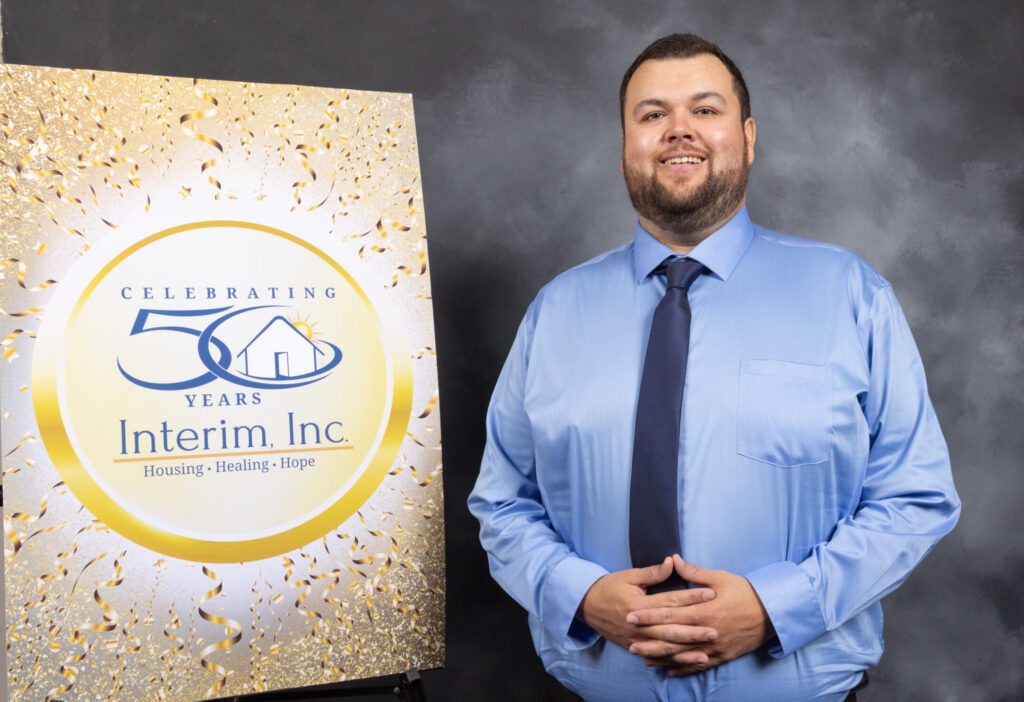
When Ryan took the stage at Interim’s Golden Gala, he shared a truth that resonated deeply with the room: “Taking that first step was the hardest part. Once I did, I finally had support everywhere I turned.”
Those words reflect the core of Ryan’s story—a journey defined not by a single moment, but by decades of resilience and an eventual choice to seek help. His path to Interim began long before he ever walked through our doors.
As a child, Ryan sensed he experienced the world differently. He picked up on nonverbal cues, worried constantly, and struggled with tasks that came naturally to other kids. Then came the losses—his father at age eight, followed by his grandparents and several other family members. Childhood quickly became layered with grief and confusion, compounded by emotional and psychological abuse from a stepfather who offered little safety or support.
Throughout adolescence, Ryan carried visible symptoms of anxiety, depression, and suicidality, yet stigma and cultural expectations kept him from receiving help. “I was told to be stronger, that it was all in my head,” he recalled. As an adult, even with the courage to seek treatment, he faced another barrier: treatment resistance. More than 60 medications brought side effects but little relief, and a difficult experience with ECT left memory gaps that ultimately derailed his career.
When life in Washington began to collapse, Ryan moved back to Monterey County, hoping to restart. Instead, he found himself trapped in another unstable environment—isolated, without space of his own, and watching a loved one’s cognitive decline unfold without support. His mental health spiraled. “I was basically living in my room for 23 hours a day,” he said. For a year and a half, hygiene, nutrition, and connection faded away.
The catalyst came when Ryan voluntarily admitted himself to CHOMP’s Behavioral Health Unit after six months of internal struggle. “That first step,” he says, “is what opened every door that followed.” After discharge, Interim’s Assertive Community Treatment (ACT) Team became his lifeline, helping him reconnect with medical providers, stabilize his mental health, and eventually secure housing at Shelter Cove.
Since then, Ryan’s progress has been extraordinary. He has lost over 80 pounds, improved his physical health, and is now on the most effective medication regimen he has ever experienced. With newfound stability, he is active in the Interim community through SOS presentations and the Peer Advisory Council. He also volunteers at Hitchcock Animal Shelter, and is rebuilding his 15-year dog-training practice—work that keeps him grounded and present.
“Life isn’t perfect,” Ryan shared, “but it’s moving forward. And that’s something I didn’t think I’d be able to say again.”
Ryan’s story exemplifies how structured peer support and lived experience contribute to a meaningful mental health recovery journey, inspiring others toward stability, purpose, and hope.
Read More Stories:
If this journey resonates, we invite you to explore more stories and milestones at: https://www.interiminc.org/interim-news/